Extraordinary tourist destinations the world never got to see
Plans that never came to be
There are enough incredible attractions the world over to fill every traveller's bucket list and then some. But there are also those whose plans never saw the light of day. From space-age hotels to soaring skyscrapers, we reveal the amazing tourist attractions that were never built.
Click through this gallery to see the awesome attractions tourists never got to see...
Clifton Suspension Bridge, Bristol, UK

Bristol's Clifton Suspension Bridge is a dramatic sight, clinging to the cliffs of the Avon Gorge and soaring over the river below. The bridge, completed in 1864, is based on plans by English engineer Isambard Kingdom Brunel, with muscle-bound towers and a mammoth deck. But earlier iterations of the bridge's design looked rather different.
Clifton Suspension Bridge, Bristol, UK

The idea for a bridge here first arose in the 1750s, when merchant William Vick left money towards the structure in his will. Architect William Bridges put forward a design (pictured) made up of a mighty stone arch, supported each side by towers of homes and factories. However, when the French Revolution kicked off, Bridges' plans were put on hold and eventually abandoned due to their steep costs. A competition was held to determine the final look of the bridge and Brunel's more pared-back design won.
Sponsored Content
Battersea Power Station theme park, London, UK

The hulking Battersea Power Station watches over the River Thames and is looked upon fondly by many Londoners. It had ceased operations entirely by the 1980s and plenty of plans for its redevelopment have been floated over the years. The wackiest of all was a brash theme park envisioned by Alton Towers' John Broome in the late 1980s. Had the project gone ahead it would have included a mall, an ice rink and Vegas-style indoor roller coasters, all surrounded by manicured gardens. However, funding was halted and the family-friendly attraction was never to be.
Watkin's Tower, London, England
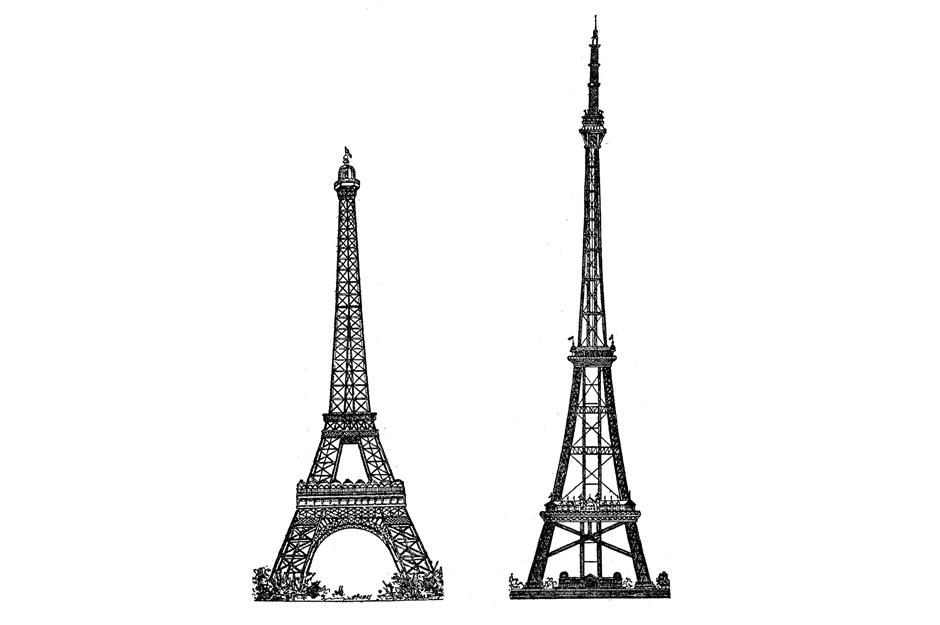
In the late 19th century, railway magnate Sir Edward William Watkin had a grand idea to get the paying public onto his trains. He decided to build the world's tallest structure – a 1,200 foot (366m) tower standing 150 feet (46m) taller than the Eiffel Tower, seen in the left of this sketch – in Wembley, then a London suburb connected to the city via Watkin's Metropolitan railway. The French architect Gustave Eiffel declined Watkin's offer to design a rival to his Parisian masterpiece, so in 1890, Watkins launched an architectural competition. Unsurprisingly, the winning design looked uncannily like La Tour Eiffel.
Watkin's Tower, London, England

The design included all manner of amenities, from a Turkish bath to a 90-room hotel. After thrilling themselves in the amusement park around the base of the tower, visitors would reach the top of the structure by an elevator. The surrounding park was a hit and the first layer of the tower was completed by 1896, but its popularity was not to last. Dwindling ticket sales and unstable foundations forced the part-built tower to close. By 1904 it had been dynamited into oblivion. Wembley Park remained popular, however; today it's the location of the 90,000-seat Wembley Stadium.
Sponsored Content
Trafalgar Square Pyramid, London, UK

Nelson's Column (pictured) dominates London's Trafalgar Square and immortalizes the lauded Admiral Horatio Nelson, who died at the Battle of Trafalgar in 1805 having defeated the French. It almost never existed, though. Politician and officer Sir Frederick William Trench wanted to commemorate the battle with something rather different: a gargantuan pyramid structure larger than St Paul's Cathedral. Luckily Trench's wishes were never fulfilled and the tribute to the late admiral was built instead.
Hotel Attraction, New York City, USA

Antoni Gaudí's architectural masterpieces are famed the world over, from Barcelona's La Sagrada Família to colorful Park Güell – and one of his fantastical creations was almost realized in New York City. In the early 20th century, two businessmen (whose identities remain unknown) called on the Spanish architect to design a whimsical hotel in Manhattan. This rocket-shaped structure, dubbed Hotel Attraction, was what Gaudí dreamed up.
Hotel Attraction, New York City, USA

The futuristic hotel would have risen to between 980 and 1,100 feet (299 to 335m), with curving towers and an opulent interior containing multiple restaurants, exhibition space, a theater and plush guest rooms. For reasons unknown, Gaudí's plans were never realized. However, the designs resurfaced in the early 2000s when they were submitted as a potential new design for the World Trade Center, after the tragic events of 9/11. Again, though, Gaudí's visions were passed over and all that remains are a handful of sketches.
Sponsored Content
Palace of the Soviets, Moscow, Russia

The imposing Palace of the Soviets, whose construction began in the late 1930s, was to serve as an administrative center, and ultimately as a show of Soviet power. It was designed by architect Boris Iofan and planned for the site of the original Cathedral of Christ the Saviour, which had been razed to the ground in 1931 on the orders of Soviet leader Joseph Stalin. The ostentatious building, crowned with a looming statue of Stalin's predecessor Lenin, would have been one of the largest structures in the world at the time.
Liking this? Click the Like button above. And click the Follow button above for more great stories from loveEXPLORING
Palace of the Soviets, Moscow, Russia

However, the German invasion of Soviet Russia in 1941 thwarted these lofty plans. Instead, the palace's foundations were turned into the Moskva pool, a mammoth outdoor swimming pool which was for a time, the largest in the world. The Soviet Union was eventually dissolved in the early 1990s and by 1995, construction of the new Cathedral of Christ the Saviour had begun. The golden-domed holy building (pictured) still stands on the site.
The Illinois, Chicago, USA

Architect Frank Lloyd Wright changed skylines all over the world and his legacy includes such buildings as New York City's Solomon R. Guggenheim Museum and Tokyo's Imperial Hotel. And nowhere was he more influential than in the city of Chicago, where he launched his esteemed career. However, not all of his designs proved a success. He planned an ambitious skyscraper The Illinois for the Windy City – and though he maintained its feasibility, it was dubbed impossible by his contemporaries.
Sponsored Content
The Illinois, Chicago, USA

Had it been built, The Illinois (pictured) would have been one mile (1,600m) high, with more than 500 storeys and room to house 100,000 people. Even today it would be the tallest building in the world, some 2,625 feet (800m) higher than Dubai's towering Burj Khalifa. Wright's plans never left the drawing board though, and the largest building in Chicago remains the diminutive 1,450-foot (442m) Willis Tower.
Wonderland Amusement Park, Beijing, China

A stone's throw from Beijing, you'll find the remnants of the Wonderland Amusement Park. It was once tipped to be China's answer to Disneyland but due to financial issues, construction on the ambitious theme park was halted in the late 1990s. It was never completed or opened, and all that remains is a fairy-tale castle, now the domain of urban explorers.
Port Disney, California, USA

The Walt Disney Company has larger-than-life parks all over the States and beyond, but Port Disney, planned for Long Beach in California, was a failed endeavour. The concept, which was introduced in 1990, would have sprawled across 443 acres and included a cruise port and theme park (named DisneySea), plus shops, resort hotels and entertainment. However, the project was met with disapproval from locals who were concerned about the site's environmental impact and heavy traffic.
Sponsored Content
Port Disney, California, USA

The project was soon forgotten in favor of WestCOT, Anaheim's answer to Florida's Epcot. However, this venture was also cancelled due to financial limitations. Some elements of the fated Port Disney live on in Tokyo's DisneySea theme park (pictured), including the site's Mysterious Island with its imposing volcano as a backdrop.
Walt Disney’s Riverfront Square, St Louis, USA

Disney almost took over the waterfront of St Louis, Missouri too. A theme park named Walt Disney's Riverfront Square was envisioned in the 1960s, just up the river from the Busch Memorial Stadium. Plans included a land themed around historic St Louis and one dedicated to New Orleans, plus a banquet hall, shops and a bar with sweeping river views. Ultimately, financial issues ensued and Walt Disney decided to set his sights elsewhere.
Mineral King, California, USA

Walt Disney's grand plans in the 1960s also included a ski resort in California. Before his death in 1966, Disney was intent on creating a winter sports paradise at the Mineral King valley in Sequoia National Park. The complex would have included a sprawling hotel, a cosy cinema, shops and ice rinks. However, questions were raised over the resort's profitability and it was widely condemned by conservationists too. Again, Disney's vision wasn't to be.
Sponsored Content
Guggenheim Helsinki, Helsinki, Finland

In the early 2010s, plans were in full swing to build a Guggenheim museum in the Finnish capital. The prestigious art museum would have been situated on Helsinki's South Harbour, Eteläsatama (pictured), and the building's design was to be decided by an international competition. The uber-modern winning design by Parisian firm Moreau Kusunoki Architects included a series of vast timber-clad buildings and a teetering tower with views over the water.
Guggenheim Helsinki, Helsinki, Finland

The waterfront museum would have joined the famed Solomon R. Guggenheim Museum in New York City (pictured). However, after lengthy debates, the Finnish government decided not to contribute the necessary funds to the museum project. The Solomon R. Guggenheim Foundation did not find alternative funding so the project ultimately fell through.
Museum of Modern Art, Caracas, Venezuela

While Venezuela's capital has little shortage of museums – with the Museum of Fine Arts a highlight – it was almost blessed with another. The Museum of Modern Art (pictured) was planned in the 1950s – perched on a cliff within the city, the museum would have been housed in an eye-catching upturned pyramid. For unknown reasons, the head-turning structure was never built.
Sponsored Content
Coney Island Globe Tower, New York City, USA

Coney Island draws millions of visitors each year with its rides, food stands and sandy beach – and another striking structure almost joined its heady mix of amusements. In the early 1900s, architect Samuel Friede announced plans for the Coney Island Globe Tower (pictured). The 700-foot (213m) building would have included an enormous sphere, containing everything from gardens and restaurants to a circus and a huge theme park.
Coney Island Globe Tower, New York City, USA

However, lengthy delays on the project ensued and as construction work failed to get off the ground, investors became suspicious. The stunted project was eventually written off as architectural fraud. Nevertheless, even without this imposing globe, Coney Island still has plenty of colourful attractions to pull in the crowds today.
Lunar Hilton Hotel, the Moon

Perhaps the most ambitious failed attraction of all, this hotel was set to be out of this world. In the 1960s, the Lunar Hilton Hotel was the brainchild of Barron Hilton. The then-president of Hilton spoke of a 100-room inn on the moon with a spectacular observation dome looking towards Earth. However, his vision never came to anything and a hotel on the moon remains a mere fantasy.
Sponsored Content
Lincoln Memorial, Washington DC, USA

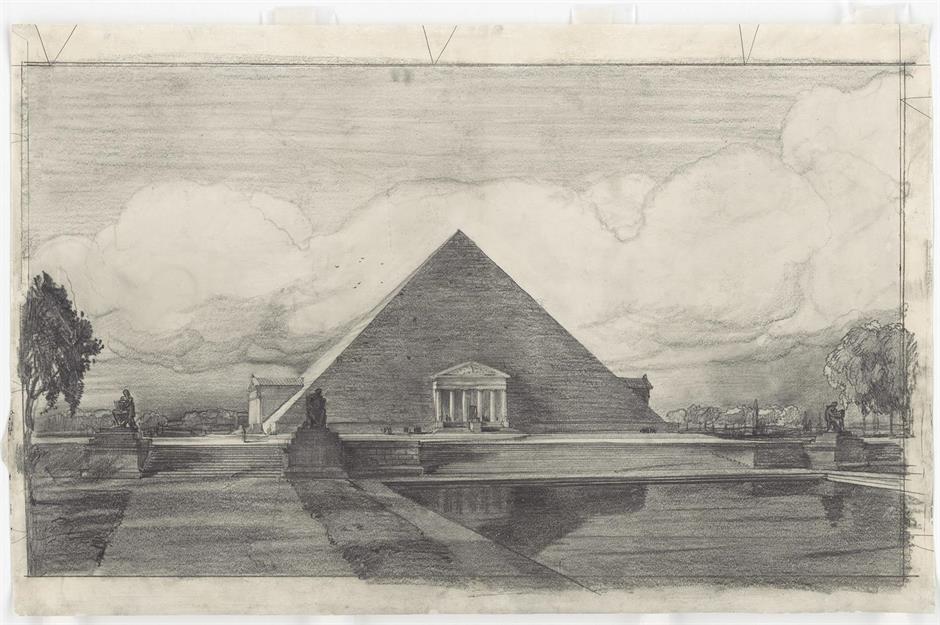
The Greek Revival-style Lincoln Memorial dominates Washington DC's National Mall, commemorating late president Abraham Lincoln. But the elegant final design of this monument faced some initial competition. Lauded architect John Russell Pope put forward several proposals for the landmark, including an Egyptian-esque pyramid fronted with porticos (pictured).
Lincoln Memorial, Washington DC, USA

Though Pope enjoyed later success with his plans for DC's Jefferson Memorial and the National Gallery, his designs for the Lincoln Memorial were rejected in favour of those by Henry Bacon (pictured). Now millions come to admire Bacon's creation each year and to view the imposing statue of President Lincoln seated within.
General Ulysses S. Grant Memorial Bridge, Washington DC, USA

This tower-studded bridge was designed in the 19th century to honour president and Civil War general Ulysses S. Grant. Spanning the Potomac River, the bridge, designed by Paul J. Pelz, would have stretched out for more than 4,000 feet (1,219m), connecting Arlington with Washington DC.
Sponsored Content
General Ulysses S. Grant Memorial Bridge, Washington DC, USA

However, funding for this bridge was blocked and, instead the simpler Arlington Memorial Bridge was completed at the site in 1932. A memorial to General Ulysses S Grant (pictured) now stands at the foot of Washington DC's Capitol Hill.
Now see the awesome American attractions that were never built
Liked this? Click the Like button above. And click the Follow button above for more great stories from loveEXPLORING