See How These Iconic Landmarks Could Be RUINED By Pollution
A smoggy outlook
Although COVID-19 restrictions led to a temporary drop in air pollution levels, the toxicity of the air we breathe has skyrocketed. In fact, the most recent IPCC report indicated that 95% of the global population lives in areas where levels of PM2.5 (fine particles) exceed the rate recommended by the World Health Organization (WHO). To draw attention to its deadly impacts, HouseFresh has modeled how world-famous views could look under a blanket of toxic smog. They emulated the visual effect of pollution in Ghaziabad, India – which has a PM2.5 level 18.2 times the WHO recommendation – on famous cities worldwide. Here are the shocking results…
Seattle, Washington, USA

Puncturing its skyline in a way that fits the name, Seattle’s famous Space Needle is easily its most recognizable. Many visitors choose to scale it for panoramic vistas, but you can also get a fantastic (and free) view of it from the top of Kerry Park, where this image was captured.
Seattle, Washington, USA

The Pacific Northwest city is blighted by three main sources of pollution: wood smoke, motor vehicles and outdoor fires. Although the latter are discouraged, recent wildfires across the region have led to significant spikes in air pollution – if these become the norm, we could get used to Seattle’s skyline looking like this.
Ranked: the US states most and least at risk from climate change
Sponsored Content
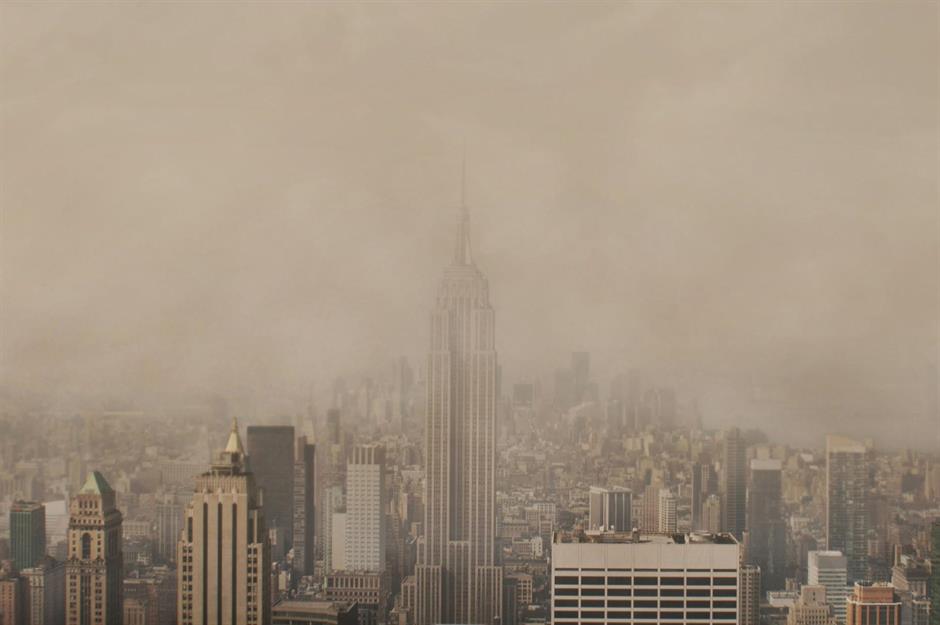
New York City, New York, USA

Visitors to the Big Apple often head to the top of the Rockefeller Center to take in this spectacular vista. In the foreground you can see the Empire State Building and the skyscrapers of Midtown, while further downtown it’s possible to glimpse Brooklyn Bridge, the Statue of Liberty and New York Harbor. But all that could disappear in years to come…
New York City, New York, USA

In fact, if air pollution reaches Ghaziabad levels, even the top of the Empire State Building will become murky while the city’s many majestic towers will disappear in the distance. Shockingly, the Department of Environmental Protection currently indicates that around 6% of deaths in the city are linked to air pollution, which has risen dramatically throughout the 20th and 21st centuries.
Hong Kong

Many visitors to Hong Kong head to the top of the 1,811-foot Victoria Peak, which offers this incredible view of the skyline. The quickest way there is to board the city’s beloved 125-year-old Peak Tram, which clatters up the hill in just eight minutes, or if you fancy a workout, you can scale the peak on foot, which takes around two hours there and back. On clear days, you can see plenty of towering skyscrapers, the harbor and Kowloon neighborhood in the distance.
Sponsored Content
Hong Kong

Yet if the city continues on its current trajectory, clear days could be few and far between. As HouseFresh point out in its report, Hong Kong’s yearly hours of reduced visibility increased fourfold in the two decades leading up to 2008, from 295 to 1,100. Its coal and gas power plants, which were emitting 320 tons of PM2.5 pollution by 2016, were cited as a huge contributor. Seen here with Ghaziabad-level pollution, the iconic panorama is half-obscured by the smoggy air.
Toronto, Canada

This spectacular view of Toronto’s gleaming skyscrapers was captured from Centre Island – one of the world’s largest car-free urban areas. Despite being home to almost three million people, Toronto is widely considered one of the least polluted major cities in the world, with a PM2.5 average that is within the WHO’s target bracket.
Toronto, Canada

Yet forest fires, which are set to become more frequent in future due to climate change, could hamper the city’s ability to control pollution. In late 2021, when northern Ontario saw a slew of wildfires, skies were obscured by a reddish haze and the city was listed as having some of the worst air quality in the world. If the city is to avoid scenes like this in the future, more must be done to curtail the blazes.
Sponsored Content
London, England, UK

With almost nine million residents and 21 million annual visitors (pre-covid), London is one of the busiest metropolises in the world. And this is arguably one of its most memorable views, featuring the famous late-19th century Tower Bridge with the river Thames snaking through it. Although the view looks ultra-clear in this image, London’s history of pollution goes back hundreds of years – in fact, it’s the city where the word ‘smog’ (a combination of ‘smoke’ and ‘fog’) was first coined, in the early 20th century.
Liking this? Click on the Follow button above for more great stories from loveEXPLORING
London, England, UK

Modelled with Ghaziabad levels of pollution, the Tower Bridge in the foreground is one of the few landmarks that remains visible while the background fades to nothingness. Thanks to recent actions to curtail air pollution, however, the city could avoid this fate. These include an expansion of the Ultra Low Emission Zone (ULEZ), which has helped slash levels of some pollutants by half, a large zero-emission bus fleet and an expansion of cycle paths.
Tokyo, Japan

Standing at a colossal 2,080 feet tall, Tokyo Skytree, from which this image was taken, is among the tallest towers in the world. For 360-degree views, visitors can head to one of its two observation decks, eat in its Sky Restaurant or walk along the Tembo Galleria – dubbed the world’s highest skywalk. But what would this stunning view look like with severe air pollution?
Sponsored Content
Tokyo, Japan

If toxic smog reached Ghaziabad levels, many of the buildings in the background would be completely obscured. Thankfully, Japan’s tough stance on pollution makes this outcome look fairly unlikely. The country began tackling air pollution from the 1970s, with a robust plan which included modernizing power stations so they’d emit fewer harmful chemicals, incentivizing businesses to make green policies and educating the public. With PM2.5 levels two points above the WHO recommended level, however, Tokyo still has a way to go.
Sydney, New South Wales, Australia

Home to just over five million people and welcoming around 39 million annual visitors in 2019, Sydney is Australia’s largest and busiest city. It gained its best-known landmark, the Sydney Opera House, in 1959, which can be viewed from Mrs. Macquarie’s Point along with Harbour Bridge in this picturesque shot.
Sydney, New South Wales, Australia

Although both landmarks are just about visible under a thick blanket of smog, it certainly takes away much of the city’s shine. Shockingly, the city’s Air Quality Index reading reached ten times the level seen as ‘hazardous’ in certain parts of the city in 2019. To mitigate pollution, authors of the Clean Air Plan for Sydney advise the phasing out of wood-powered heaters, new policies to reduce the number of cars on the road and a phasing out of diesel vehicles, among other measures.
Sponsored Content
Rio de Janeiro, Brazil

The second-largest metropolis in Brazil with a population of roughly 6.7 million, Rio de Janeiro’s best-known landmark has to be the iconic 130-foot (40m) Christ the Redeemer statue. You can either climb to the top, where there’s a 360-degree observation deck, or hop on a cable car to the top of Corcovado mountain. At 1,300 feet above sea level, this vantage point offers a unique bird’s-eye view across the city.
Rio de Janeiro, Brazil

Sadly, Rio’s majestic statue could become a faint memory of what it once was, if air pollution reaches Ghaziabad levels, as modelled here. In 2016, an analysis of government data found that Rio’s air was dirtier and deadlier than authorities had previously indicated, with PM2.5 levels regularly reaching two to three times the annual limit recommended by the WHO. High levels of road traffic are the biggest factor contributing to the city's murky air.
Rome, Italy

Climbing to the top of St. Peter’s Basilica allows you to take in Michelangelo’s masterpiece from all angles, before gazing out at this memorable view of the Vatican City and Rome. Yet the 400-year-old, Renaissance-style church hid an ugly secret until recently. If you took a closer look, you’d see its walls were blackened and discolored due to air pollution. Although a recent renovation has removed the damage, the city’s high levels of toxic smog remain.
Sponsored Content
Rome, Italy

As shown, the historic viewpoint could be largely obscured if air pollution reaches Ghaziabad levels. While the decision to ban diesel cars by 2024 and other curbs to traffic are a step in the right direction, Rome and Italy still have a long way to go to cut the smog. In fact, Italy had the highest number of pollution-related deaths in Europe in 2012.
Paris, France

Probably one of the most famous buildings in the world, the Eiffel Tower was completed in 1889 and since then it’s become a memorable fixture of Paris’ skyline. The city, which is home to just over two million people and brought in around 30 million tourists a year (pre-pandemic), has the not-so-prestigious accolade of being the second-most polluted city in France.
Paris, France

In 2019, the French state lost a landmark case against a mother and daughter with respiratory problems, who claimed that they had failed to tackle air pollution levels in Paris. Then two years later, the French government was fined €10 million ($12m/£10m) for its lack of action to curtail toxic smog. It seems the city is finally beginning to take note of the crisis. Recent measures put in place include the promotion of public transport, implementation of low-emission zones and a plan to ban diesel cars in the city by 2024.
Liked this? Click on the Follow button above for more great stories from loveEXPLORING
Discover the shocking images which show the true impact of climate change