50 unforgettable experiences you can only have in New Zealand
Kiwi experiences you've been missing
Sailing Auckland's harbour

Charter a sailboat or join a cruise to experience Auckland’s Waitematā Harbour from the water. The City of Sails, as it's also known, has a rich maritime heritage and when you’ve learned all you can about Polynesian and European history in its museums, nothing beats seeing Auckland’s skyline with the wind in your hair. There's even an option to book an ex-America's Cup sailing yacht.
Hiking the Tongariro Alpine Crossing

The central North Island region features the one-day Tongariro Alpine Crossing. Famed for its views of magnificent lava fields, smoking craters, volcanic lakes and Mount Ngauruhoe (known as Mount Doom in The Lord of the Rings), it's lauded as one of the world's best one-day hikes. In winter, the track is covered in snow and ice. The hike takes six to eight hours to complete and covers around 12 miles (19.4km). Note that it's a point-to-point hike, so travellers are advised to arrange pick-up at the end of the trail.
Sponsored Content
Sandboarding Giant Sand Dunes
Braving a skydive

Queenstown in the South Island is the adventure capital of New Zealand. Braving a skydive from 15,000 feet (4,572m) is the ultimate high-octane experience and after an exhilarating (and terrifying) 60-second freefall you can enjoy a scenic parachute ride over beautiful and dramatic scenery – drop zones include the base of the Remarkables mountain range.
Visiting Hobbiton Movie Set

Kiwi film director Sir Peter Jackson shot much of The Lord of the Rings trilogy on location in the epic landscapes of New Zealand. Hobbiton, however, was built from scratch (and rebuilt for The Hobbit) on farmland just outside the small Waikato town of Matamata. The movie set is now one of the country’s most visited tourist attractions and offers guided tours, dinner feasts, special weekend breakfast experiences and more.
Sponsored Content
Riding the New Zealand Cycle Trail

The New Zealand Cycle Trail is a series of 22 mostly off-road cycle routes that take anything from a couple of hours to several days. Alps 2 Ocean (pictured) is an epic route that follows glacier-carved valleys from the foot of the Southern Alps to the Pacific Ocean on the South Island and takes four to six days to complete. It's mostly pretty easy but can be lumpy with steep drop offs in places.
Touring world-class wineries

A flight over an active volcano

In northern New Zealand’s Bay of Plenty, White Island – or Whakaari in Māori – is an active marine volcano that last erupted in December 2019. There were 47 people on the island at the time and 22 tragically lost their lives when rock and ash was exploded into the air. Visitors can no longer set foot on White Island, but you can take a scenic flight from Whakatane, Rotorua, Tauranga or Taupo to see the often-smoking crater up close.
Sponsored Content
Visiting a marae

Driving Ninety Mile Beach

The far north’s Ninety Mile Beach is officially a highway – but one that's only suitable for 4WD vehicles. Beefed-up minibuses regularly run tours up and down the sands from Kaitaia to Scott Point, while more adventurous travellers tackle the sands in their own vehicles (though rental cars don't allow you to drive on the beach). A seemingly never-ending stretch of sand, Ninety Mile Beach, which is actually 55 miles (88.5km) long, is famed for spectacular sunsets and one of the best left-hand surf breaks in the world.
Exploring Farewell Spit

There are plenty of spots other than Ninety Mile Beach where you can take a drive on the sands, though. At the far north of the South Island in Golden Bay, narrow Farewell Spit is a protected nature reserve and bird sanctuary with bar-tailed godwits, knots, curlews, whimbrels, turnstones and breeding blue penguins. Just one tour company has permission to operate here, allowing visitors to explore the 21-mile (34km) stretch of windswept sands backed by ever-moving dunes on a 4WD minibus.
Sponsored Content
Jet-boating on the Shotover River

The unbelievably blue waters of the fast-flowing Shotover River are a mesmerising spot for jet-boating on the Shotover Jet. Your heart is in your mouth as you race through the rocky and narrow canyon, skimming rocks and spinning through sharp turns. The jet is owned by the Ngāi Tahu, the Māori people of this land, and is the only company allowed to operate in this area of the river.
Bungy jumping in Queenstown

Queenstown is the home of the bungy and seems to bring out the adventurous side to every visitor. There are plenty of opportunities for bungy jumping from lofty bridges and ledges in and around town – be like the pros and throw in a flip or twist as you hurtle off. Pictured is the 154-foot (134m) Nevis Bungy – the highest in New Zealand, offering an incredible 8.5-second free fall.
Bathing on Hot Water Beach

Join the throngs of people as the tide rolls out on Hot Water Beach on the east of the North Island. Grab a spade (you can hire one from a nearby café) and head to the southern end of the beach where you can dig your very own hot pool and immerse yourself in naturally heated water. It's one beach experience that's even better on a rainy day.
Sponsored Content
Discovering Wai-O-Tapu thermal wonderland

The Wai-O-Tapu thermal wonderland is close to Rotorua, a place revered by Māori (Wai-O-Tapu means sacred waters). The geothermal playground has mud pools, geysers and sulphur pools. Although there's a distinct rotten egg whiff in the air, the views are nothing short of stunning.
Feasting at a Māori hāngi

Māori traditionally used the natural geothermal heat of Rotorua as a subterranean oven. At the Te Puia Māori cultural centre you can enjoy a hāngi buffet lunch that includes chicken and lamb dishes cooked in a pit dug in the earth. As New Zealand reopens, hāngi experiences are also expected to return at Whakarewarewa and Tamaki Māori Village.
Being dazzled by Cathedral Cove

Sponsored Content
Exploring Waitomo Glowworm Caves

The Waitomo region on the North Island has plenty of limestone caves to explore and a boat ride through the dimly lit Waitomo Glowworm Caves is unmissable. Gliding along in silence with the cavern lit by what looks like thousands of stars is a magical experience.
White-water rafting on Kaituna River

New Zealand has some of the best white-water rafting in the world and Kaituna River near Rotorua is no exception. The river – one of the warmest in New Zealand – can be rafted year-round, but spring (September, October and November), is when the waterfalls are particularly epic. Kaituna Cascades offer 50-minute Grade 5 rafting tours tackling 14 rapids along the river.
Riding the TranzAlpine Express

The stupendous scenery of the TranzAlpine rail route between Christchurch and Greymouth takes in the Canterbury Plains, Southern Alps (jump off to explore Arthur's Pass), lush lake valleys and native beech forests. The train goes through short tunnels and crosses dramatic viaducts on its five-hour journey. Currently, face masks are required, even in the open-air viewing carriage.
Sponsored Content
Cruising Cook Strait

Crossing the Cook Strait on the Interislander ferry between Wellington on the North Island and Picton on the South Island is a scenic ride. On the laid-back three-and-a-half-hour crossing, you’ll have unparalleled views of the Marlborough Sounds (pictured) and might spot seals, penguins, whales and dolphins.
Stargazing in the Southern Hemisphere

For an invigorated sense of wonder at the galaxy, enjoy a night-time visit to the Aoraki-Mackenzie Dark-Sky Reserve, which includes Canterbury University’s Mount John Observatory (pictured) above Lake Tekapo, or travel to the southernmost Dark Sky Sanctuary in the world on Stewart Island/Rakiura. It's a truly magical experience.
Skiing the Southern Alps

Sponsored Content
Kayaking in Abel Tasman National Park

The outstanding coastline of Abel Tasman National Park is the main reason to visit and paddling the picturesque islets and islands is an unmissable experience. From a kayak, you’re able to access secluded golden sand beaches that can’t be reached on foot. This might be the country's smallest national park, but it's perfectly formed for fabulous adventures that are not too strenuous.
Tramping in Westland Tai Poutini National Park

Viewing the world’s clearest freshwater springs

Golden Bay’s Te Waikoropupu Springs (which translates as 'place of the dancing sands') is a serene spot to visit. While you can’t swim (the springs are a taonga, or treasure, to Māori), the stroll through the forest follows the stream and emerges at a viewing platform over the crystal-clear waters, some of the clearest in the world.
Sponsored Content
Immersing in art at Auckland Art Gallery

Auckland Art Gallery (Toi o Tāmaki) impresses from the outset. The building has a strong connection to Albert Park, which was once the site of a Māori pā (village site or hill fort). Māori commissions form part of the fabric of the building and exhibitions are world-class.
Discovering giant kauri trees

Kauri trees can grow to more than 164 feet (50m) tall and once dominated the forests of the North Island. However, logging wiped out huge swathes of land and only a few kauri still stand. Waipoua Forest is one of the best places to have a close encounter with a kauri tree, several of which are more than 2,000 years old. Footprints Waipoua offer tours to visit these ancient giants from Opononi in Northland.
Whale watching off the Kaikoura Peninsula

Sponsored Content
Surfing Raglan, Waikato

The 1966 surf classic Endless Summer was filmed in Raglan and it’s a popular spot with surfers. The long peeling left-hand break at world-famous Manu Bay (five miles, or 8km, from Raglan) can get a little crowded, so Ngarunui (Ocean) Beach might be a better choice for beginners.
Ice climbing on the Southern Alps

Getting up close to penguins

The world’s rarest species of penguin, the yellow-eyed penguin (Megadyptes antipodes), or hoiho, can be spotted at Curio Bay in The Catlins. The southeast corner of the South Island is home to these protected birds and it’s estimated there are only around 6,000 to 7,000 of them left in the wild in New Zealand.
Sponsored Content
Paddleboarding Poor Knights Island

Cruising Milford Sound

South Island’s Fiordland National Park is one of the most pristine and spectacular places on the planet. The vast fiord known as Milford Sound, or Piopiotahi in the Māori language, has sheer rock walls rising 5,522 feet (1,683m) and a daytime or overnight cruise gives a unique perspective.
Searching for a kiwi

Sponsored Content
Paddling a waka

More than 800 years ago Māori arrived in New Zealand on waka (canoes) from eastern Polynesia. Learning about Māori heritage while paddling as a team along the beautiful Abel Tasman coast in single or double-hulled outrigger canoes is a special experience. Visitors learn the etiquette (tikanga) associated with waka before beginning the journey along the coast to Split Apple Rock. All trips also begin and end with a blessing (karakia) for protection.
Soaking in hot springs

There are plenty of hot springs in New Zealand, but Kerosene Creek (around a 30-minute drive from Rotorua) is totally free. Here, the tumbling waterfall and naturally heated hot pool is at the end of a short track and surrounded by native forest. For a more commercial experience, visit Ngawha in Northland, where 16 geothermal pools have recently been redeveloped and reopened in 2021. The Parahirahi Ngawha Waiariki Trust owns and operates Ngawha and upholds the cultural and spiritual values of the springs.
Visiting Cape Reinga

Standing at the lighthouse at the far north of New Zealand looking out at the Tasman Sea and the Pacific Ocean colliding, you can feel why it’s such a special place for Māori. This sacred site at the end of the road marks the point from which Māori wairua (spirit) return to their traditional homeland. While it's not the most northern point of the country (North Cape is, but it's not open to public), this is as far as you can get by road. There are guided coach tours departing from Kaitaia and Paihia daily too.
Sponsored Content
Walking the Pancake Rocks track

Fishing in the Tongariro River

The Tongariro River is the most important spawning habitat in the Great Lake Taupo region. The river runs through Turangi, which makes a great base for anyone keen on fly fishing for world-renowned rainbow trout. Tongariro Lodge has been offering guided experiences to over 40 rivers and three lakes since 1982 in the Lake Taupo region, including in the Tongariro River.
Cruising through the Hole in the Rock

The Bay of Islands is a watery wonderland with more than 100 offshore subtropical islands to explore. The talisman of the region is the Hole in the Rock (Piercy Island) – a spectacular rock formation that is possible to cruise right through on a calm day. Half-day tours leave from Paihia.
Sponsored Content
Touring “Wellywood”

Wellington is the capital of the New Zealand film industry and Miramar peninsula, 20-minutes from downtown, is where all the action happens. You can tour the digital workshop to get insight into the special effects that turn fantasy movies like The Lord of the Rings and District 9 into reality and visit Wētā Cave (pictured) to buy props and merchandise made by the artists who work on the films.
Stocking up at a farmers' market

On weekend mornings locals in every part of the country flock to their local farmers’ market to pick up fresh local produce. Buzzing markets include La Cigale French Market (in Auckland), Harbourside Market (in Wellington), Nelson Farmers Market, Christchurch Farmers' Market and Matakana Village Farmers' Market, pictured, which is zero waste.
Taking in an All Blacks haka

The haka is a complex dance and traditional Māori challenge that tribes built their reputation on. The intensity and ferocity of the All Blacks performing either Ka Mate or their own haka Kapa O Pango before a game is not easily forgotten. Catch a game at one of the international stadiums across New Zealand, from Auckland to Dunedin.
Sponsored Content
Hot air ballooning over the Canterbury Plains

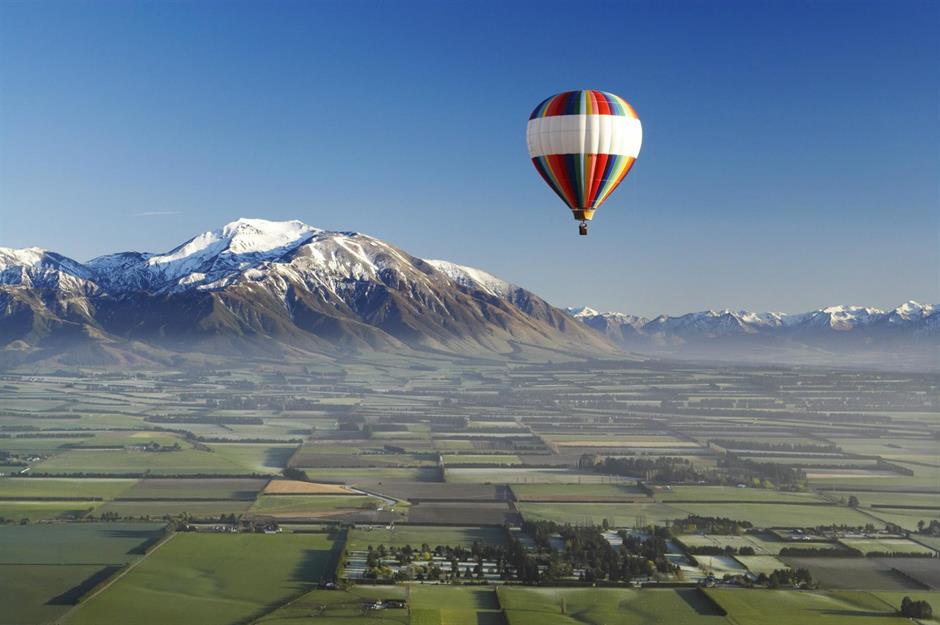
Floating over the panoramic Canterbury Plains landscape is a never-to-be-forgotten experience. Hot air ballooning here is at its most magical and peaceful at sunrise. Ballooning Canterbury offers hour-long flights and balloon fiestas where you have the opportunity to float among other balloons.
Carving pounamu (New Zealand greenstone)

Wood, stone and bone carving are prestigious art forms practiced by master carvers. Spending a day or more learning traditional Māori skills is a wonderful opportunity to learn more about all aspects of Māori culture (and you take home something you made with your own hands). You'll find many places that offer carving experiences all across the country.
Riding the trams in Christchurch

A devastating earthquake in 2011 changed the skyline of Christchurch, on the South Island, forever. Luckily, the city's quaint heritage trams remain. They operate a hop-on-hop-off tour of the inner city, taking in all the major tourist sites (17 of them). Cathedral Square, where Christchurch Cathedral is being rebuilt to look much like the 1904 original, sits along the route as does the new Riverside Market on the banks of the Avon River. It has sprung up as part of the regeneration of the city.
Sponsored Content
Embracing freedom camping

Sure, there are restrictions on where you can camp, but New Zealand has many beautiful untouched spots where it’s possible to pitch or park up for free. Nothing beats the freedom of driving off the beaten track to set up a remote camp under the stars. Travel New Zealand has lots of valuable information when it comes to freedom camping. "While it is free of charge, it is not free of responsibility," they say, so read up before planning a trip.
Hiking New Zealand's newest Great Walk

A new edition to the famous Great Walks of New Zealand, the Tuatapere Hump Ridge Track is set to open at the end of 2022. This three-day, 38-mile (61km) loop through Fiordland gives access to sensational southern coastline, native forests, limestone tors and historic viaducts. Trampers must book the two backcountry lodges in advance – Okaka at 3,281 feet (1,000m) and Port Craig at sea level.
High-altitude heliskiing

New Zealand has some stunning high-altitude destinations for heliskiing. Take a chopper from Queenstown or Wanaka to the Southern Alps or to Aoraki Mount Cook, where you'll land in the best dry powder snow and can take a number of runs. You need to be a strong skier, but there's a wide range of terrain so it's possible to be dropped somewhere a little less advanced. Powder skis or all-mountain skis are recommended. Tourism New Zealand offers a handy guide to companies offering heliskiing experiences.