Enormously expensive megaprojects around the world that still aren't finished
Plans plagued by delays and escalating costs
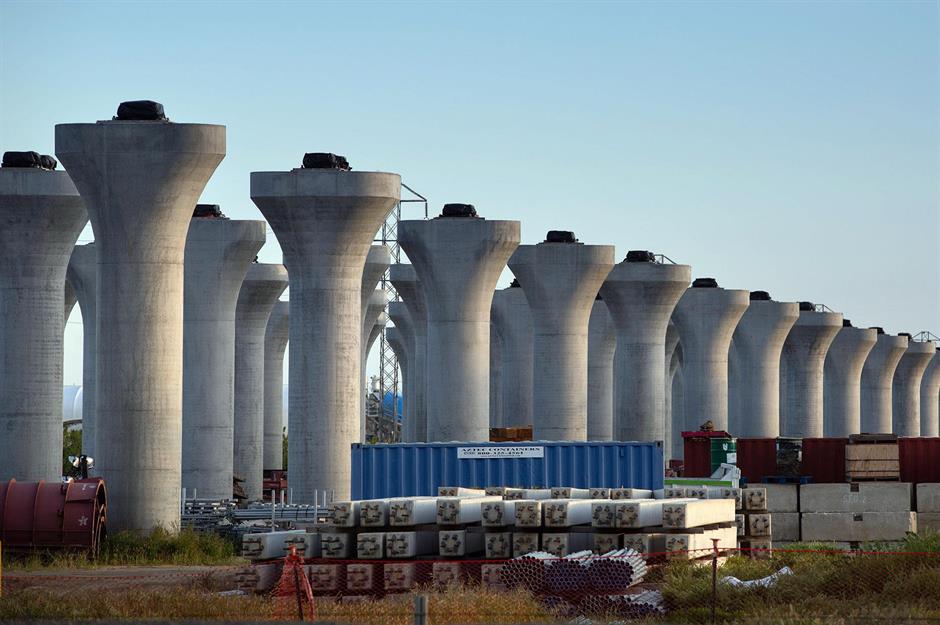
Projects of immense scale are never easy to execute, so it's no surprise that many are delivered late and massively over budget. The impacts of COVID-19, runaway inflation, and supply chain issues are all recent factors that have delayed flagship megaprojects around the world. Unfortunately, general mismanagement and political disputes also play their part.
From power plants to high-speed rail networks, read on to discover the staggering costs of some notoriously problematic projects and find out why they're running so far behind schedule.
All dollar amounts in US dollars unless otherwise stated.
Navi Mumbai International Airport, India

Designed by the world-renowned Zaha Hadid Architects, Mumbai's shiny new international airport was first proposed back in 1997.
The project was eventually given the green light in 2008 but has been marred by conflict, mainly between government departments.
Bitter disagreements over the location, protests from local villagers, and concerns over the ecological impact of the airport that put India's environment and civil aviation ministers at loggerheads are just some of the issues that have delayed the project so far.
Navi Mumbai International Airport, India

Foundations were finally laid in February 2018, but the estimated phase one completion date of April 2019 couldn't be met.
The state of Maharashtra, where Mumbai is located, hoped the airport would be ready to launch its first flight by December 2020. However, construction of the runway hadn't even started by the end of 2019 due to nearby residents' reluctance to relocate.
Further financial issues have impacted the project's progress, with the original budget of $692 million (£567m) more than tripling to $2.1 billion (£1.7bn).
Sponsored Content
Navi Mumbai International Airport, India

The pandemic also put a stop to construction on the site, with the airport's managing director revealing the megaproject would be delayed again. In November 2020, then-Maharashtra chief minister Uddhav Thackeray set a new completion deadline of May 2021 for the first phase. He also warned that further delays wouldn't be tolerated, with the new airport viewed as crucial for securing future investment in India’s largest planned city.
Despite that sense of urgency, the May deadline came... and went. The most recent time frame suggests the airport's phase one should be fully operational by early 2025, almost three decades after it was first proposed. However, construction of the entire facility isn't expected to be finished before 2032.
Stuttgart 21 rail project, Germany

Proposed with the intention of overhauling the region's railway system, the Stuttgart 21 project in southern Germany has been controversial from the very start.
The megaproject was officially announced in 1994 with an estimated price tag of €2.5 billion ($2.7bn/£2.2bn), although construction work didn't actually start until 2010.
Stuttgart 21 rail project, Germany

Unexpected increases in construction expenses and environmental regulations – including the relocation of thousands of lizards in 2017 – have delayed the construction of the massive new train station in Stuttgart, along with several of its tunnels and about 50 miles (80km) of new railway tracks.
The initial completion deadline of 2019 couldn't be met, and costs have been spiralling out of control.
Sponsored Content
Stuttgart 21 rail project, Germany

In January 2018, rail company Deutsche Bahn approved a financing framework of €8.2 billion ($9.3bn/£7.3bn) for the project, pushing it €5.7 billion ($6bn/£5.3bn) over the original estimate.
The project celebrated a significant milestone in 2023: the final tunnelling works were completed in September and the project is now on track to be finished by late 2025. However, its overall cost has risen to €9.15 billion ($9.8bn/£7.9bn) due to higher prices and increased geological risks.
Hinkley Point C, UK

The UK government approved the construction of the Hinkley Point C nuclear power plant back in 2016.
Located in Somerset, England, it has two accolades to its name: not only is it the first nuclear plant to be built in the UK in almost 30 years, but it's also set to be the world's most expensive.
And the budget for this controversial megaproject keeps going up. In 2016 EDF Energy announced the plant would cost £18 billion ($22.3bn). This price tag has been repeatedly revised, with some of the most recent estimates suggesting it will actually cost £32 billion ($39.6bn).
Hinkley Point C, UK

As well as blowing its budget, Hinkley Point C is behind schedule.
The concrete base of the first reactor was completed in June 2019, while the base of the second reactor was finished, on time, in the summer of 2020.
However, in a statement released in January 2021, EDF announced that it didn't expect Unit 1 to start generating electricity until June 2026, around six months later than its original target of late 2025.
Sponsored Content
Hinkley Point C, UK

Some of the construction delays stemmed from the pandemic when work was postponed to enable social distancing. By May 2022, EDF had pushed the deadline back even further to 2027, saying labour shortages and inflation were creating issues.
Last year, the contractor started the final offshore work to install massive vertical shafts into the seabed and installed the 245-tonne steel dome that will cap the reactor – two major construction milestones. The power plant's final price tag is now estimated at £33 billion ($41bn), substantially above its original budget of £18 billion ($22.3bn).
Flamanville 3 nuclear reactor, France

Construction began on a new reactor at the Flamanville Nuclear Power Plant in northern France in December 2007.
Owner and operator EDF originally budgeted €3.3 billion ($4.9bn/£3.9bn) for the project and said it would take 54 months (four and a half years) to complete.
Flamanville 3 nuclear reactor, France

Commercial operations were scheduled to start in 2012. Yet many problems, ranging from safety concerns to equipment issues, have put a major spanner in the works, delaying the project significantly and adding billions to the cost.
An initial decree from the French government stated that fuel loading at the new reactor must be completed within 13 years of the construction work starting in 2007. However, a new decree was published in March 2020 extending that initial deadline to April 2024. The loading of fuel into the reactor was forecast to happen by the end of 2022, but this deadline was missed due to faulty welds and corroded safety valves.
Sponsored Content
Flamanville 3 nuclear reactor, France

The completion deadline is set for the first quarter of 2024. However, with complicated repairs on the overdue project, the budget has increased accordingly. The reactor is now expected to cost the French energy firm €13.2 billion ($14.2bn/£11.4bn), marking an increase of nearly €10 billion ($10.7bn/£8.6bn).
Adding to the delays, if the project achieves its latest deadline, it will actually need to shut down shortly afterwards to replace a component of the vessel in compliance with French nuclear regulations, which have stated the vessel head must be replaced at the end of the reactor's first operating cycle.
Gulf Railway Line, Persian Gulf Countries

Upon its completion, the Gulf Railway Line will connect the six Gulf Corporation Council (GCC) member states: the United Arab Emirates, Saudi Arabia, Oman, Qatar, Kuwait, and Bahrain.
The total length of the track will be 1,353 miles (2,177km), with each state organising the construction of the project within its own territory. Plans were originally approved back in 2009. Original estimates suggested the line would cost around $14 billion (£10.5bn) and be operational by 2018.
Gulf Railway Line, Persian Gulf Countries

However, that hasn't been the case.
By 2016, several partner countries had suspended work on their projects due to a lack of funds from the collapse of oil prices in 2014-2015. Dr Sulaiman al-Hamdan, the Minister for Transport in Saudi Arabia at the time, announced that a large portion of the project in his country had been completed. However, conflicting sources suggested the construction work hadn't even begun...
Sponsored Content
Gulf Railway Line, Persian Gulf Countries

Investment in railway infrastructure continued in some areas, though, with the UAE completing a 159-mile (256km) line between Dubai and Abu Dhabi. Then, in 2022, the Gulf Railway Line found major momentum, with Saudi Arabia confirming it too had built 125 miles (200km) of rail for the project. Other countries have renewed their efforts to start construction.
The total cost of the project, which is split between the six involved nations, is now tipped to be more than $250 billion (£202bn), nearly 18 times the original budget of $14 billion (£11.3bn).
Vogtle Electric Generating Plant, USA

Located in Georgia, USA, the Vogtle Electric Generating Plant is a nuclear power plant that became operational in the 1980s.
Units 1 and 2 of the plant consist of a pressurised water reactor, steam turbine, and electric generator that collectively generate 2,430 megawatts of electricity. That's comfortably enough to power more than half a million homes.
In 2006 the site applied to build Units 3 and 4, which would allow it to increase its nuclear capacity. But although the plans were approved back in 2009, progress has been slow and expensive...
Vogtle Electric Generating Plant, USA

The new units, which are 60 storeys tall, are the first nuclear power plants to be built in the US for over 30 years.
According to the plans, Unit 3 should have been operational in 2016 and Unit 4 should have followed in 2017. But Japan's 2011 Fukushima disaster caused progress to stall, with anti-nuclear campaigners filing a lawsuit against the plant due to safety concerns.
Sponsored Content
Vogtle Electric Generating Plant, USA

To make matters worse, power company Westinghouse – which was responsible for designing, building and managing the megaproject – went bankrupt in 2017 after spending $3.7 billion (£3bn).
The work was taken over by Southern Nuclear but delays have followed and, while Unit 3 went online in late July 2023, Unit 4 is still in testing and won't go into service until later this year.
The total cost of the project has soared to more than $31 billion (£25bn), more than double the original budget of $14 billion (£11.3bn). However, this doesn't include the money spent by Westinghouse.
California High-Speed Rail, USA

Since the early 1980s, California has been planning to connect the state's largest cities via a high-speed train line.
In a 2008 referendum, voters approved a $9.95 billion (£6.6bn) budget to begin construction of an 800-mile (1,287km) rail link.
With an estimated total cost of $40 billion (£32.3bn), the project promised to take travellers from Los Angeles to San Francisco in just two hours and 40 minutes.
California High-Speed Rail, USA

However, the megaproject has been delayed by protests, lawsuits, and planning issues from the outset. Construction on an approximately 200-mile (320km) segment finally began in 2015, almost three years behind schedule.
Project costs had skyrocketed to $77 billion (£62bn) by 2019 when President Trump's administration cancelled a grant worth nearly a billion dollars. This was swiftly followed by the pandemic, which also resulted in cuts to funding.
Sponsored Content
California High-Speed Rail, USA

Though the election of President Biden has proven to be good news for this megaproject – his administration reinstated the revoked funding – the costs keep mounting.
In 2022, the California High Speed Rail Authority (CHRSA) released a business plan outlining a smaller project of only 500 miles (800km) with a much steeper final cost of $105 billion (£85bn). In 2023, CHRSA increased the budget to $128 billion (£103bn) with no word on when the system will be ready, but reportedly hopes the initial 200-mile (320km) segment might be in service in 2030-33.
HS2, UK

High Speed 2, better known as HS2, is a high-speed railway line currently under construction in the UK. Initially, it was envisioned that the 330-mile (530km) railway would connect London to cities in the north of England, including Manchester and Leeds.
The plan was originally proposed in 2009, with a route agreed upon the following year. Authorities announced that phase one of the megaproject, which would carry passengers between London and Birmingham in 52 minutes, would be up and running by 2026.
But more than a decade after the plans were first unveiled, work on the £33 billion ($41bn) railway has been derailed...
HS2, UK

The controversial megaproject has been met with fierce opposition due to its environmental impact and eye-watering price tag.
Construction of the railway line will destroy almost 900 properties, 1,000 businesses, and 60 historic woodlands. Although HS2 has been billed as an eco-friendly alternative to cars, carbon modelling has suggested the project's carbon dioxide emissions could actually exceed any potential savings.
Widespread protests have contributed to HS2's ever-extending timeline, while unforeseen costs have caused the budget to balloon. Barely a month after construction officially began in 2020, the cost of the railway had already rocketed to £106 billion ($131bn) and the completion date of phase two had been rescheduled to as late as 2040.
Sponsored Content
HS2, UK

The project has since faced the chopping block. A third phase – which would have carried passengers between London and the northern city of Leeds – has been scrapped entirely, with the government hoping to keep the price closer to £96 billion ($119bn). That's nearly three times the original estimate of £33 billion ($41bn).
Prime minister Rishi Sunak then cancelled the northern section between Birmingham and Manchester in October 2023, saying the move would save £36 billion ($45bn). While the government is still revising its cost estimates, other reports estimate the London to Birmingham line alone will still cost as much as £68 billion (£84bn).
Construction of the rail project is ongoing, and the shortened line is now expected to open between 2029 and 2033, instead of 2026.
Liked this? Click on the Follow button above for more great stories from loveEXPLORING