These Abandoned Australian Towns Will Give You The Chills
The lost towns of Oz
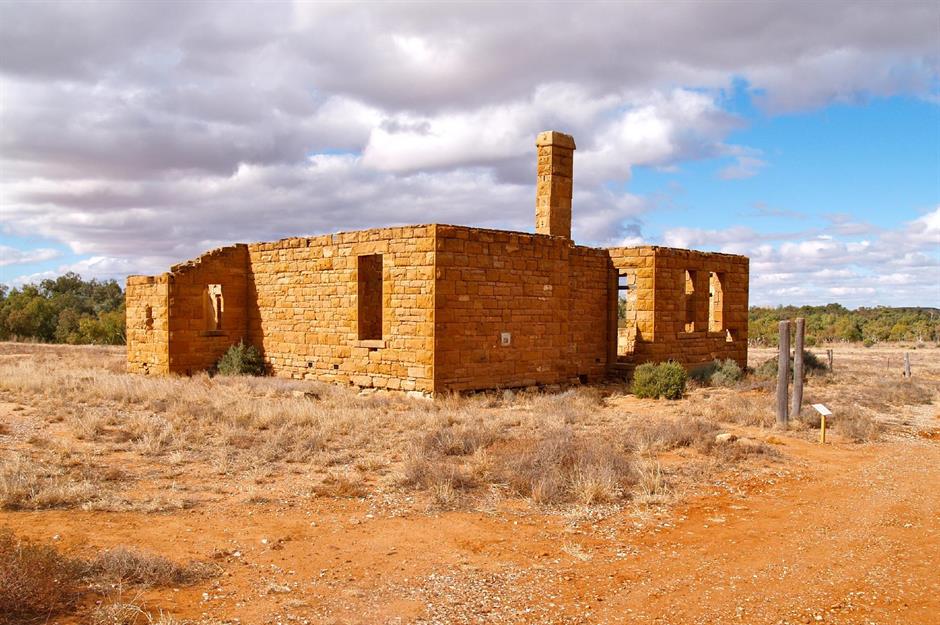
Farina, South Australia

Farina, South Australia

Sponsored Content
Farina, South Australia

Silverton, New South Wales

This dusty New South Wales town, a stone's throw west of Broken Hill City, was once a booming mining hub. It sprang up in the early 1880s after prospectors struck silver in the region and hundreds of miners descended on the area. By the mid-1880s, some 3,000 miners had made their home here – the town had houses and businesses galore, and even its very own newspaper, the Silver Age.
Silverton, New South Wales

Sponsored Content
Silverton, New South Wales

The former mining town now draws in plenty of visitors, who come to tour the shuttered Day Dream Mine and sink a pint at the age-old Silverton Hotel. An impressive number of movies have been filmed here too, from 1960s horror Journey into Darkness to Mad Max 2 – there's even a museum dedicated to the latter. A small community of artists also practice their craft among the moldering buildings, and travelers can duck into a number of pocket-sized galleries during their visit.
Hartley, New South Wales

Hartley, New South Wales

Sponsored Content
Linda, Tasmania

Now a languishing ghost town, Linda thrived towards the end of the 19th century, when the North Mount Lyell Mine was in operation. It had a somewhat debaucherous reputation, known for its serious brawls and bust-ups, and was also the terminus for the North Mount Lyell Railway, the mining company's own railroad. Unfortunately for Linda, the mine was bought out by a new company in 1903 and the town's importance immediately diminished.
Love this? Follow our Facebook page for more travel inspiration
Linda, Tasmania

Waukaringa, South Australia

Sponsored Content
Waukaringa, South Australia

Cook, South Australia

The teeny tiny railway town of Cook has always been small: this Trans-Australian railway stop on the Nullarbor Plain had about 50 residents at its peak, most of whom worked on the railway tracks themselves. Established in 1917, Cook flourished up until 1997, when the railways were privatized and most of its inhabitants moved on. Today it's practically a ghost town, with as little as four residents and some decrepit buildings, welcoming straggling tourists who've hopped off the train to stretch their legs.
Darlington, Tasmania

Sponsored Content
Darlington, Tasmania

Menzies, Western Australia

Menzies, Western Australia

Sponsored Content
Broad Arrow, Western Australia

A lone pub and this imposing water tower are really all that remains of Broad Arrow, a former mining town in Western Australia, around 25 miles (40km) north of Kalgoorlie city. Long inhabited by the Aboriginal Wangkatha people, the area saw an influx of miners in the 1890s and the population grew to more than 2,000 – by the 1920s, though, most had moved on. You can still sup a beer in the Broad Arrow Tavern, which was built back in 1896.
Hill End, New South Wales

This mining ghost town has been painstakingly preserved and, as such, is a popular tourist attraction today. The gold rush in the region began in the 1850s and Hill End soon sprang into existence – by the 1870s, it had bloomed into a town complete with churches, 28 pubs, loads of shops and the Royal Hotel, which is heritage-listed today. The town's population dwindled through the 20th century as gold reserves depleted, and today the remaining buildings act as a symbol of the region's mining past.
Hill End, New South Wales

Visitors can take a self-guided tour of the historic town (just pick up a map from the visitor center), pausing to admire intact buildings such as the general store, the post office and the Royal Hotel. For more insight into mining history, take a guided tour of the Bald Hill Tourist Mine or pore over relics from the era at the History Hill Museum. If you want to make a long weekend of it, overnight in the 1872 Royal Hotel itself.
Sponsored Content
Arltunga, Northern Territory

Cassilis, Victoria

A little town in Scotland's Ayrshire gave this former mining town – and now atmospheric ghost town – its name. Some 500 people called the settlement home, after quartz reefs bearing gold were discover in 1885, and the town was soon home to a pair of mines, schools, hotels, a vast coffee palace and a hydroelectric power station. Of course, the gold dried up as quickly as it was discovered, and 1939 bush fires also destroyed a swathe of the town – by the 1930s it was a shadow of what it once was.
Cassilis, Victoria

Sponsored Content
Kuridala, Queensland

Terowie, South Australia

Terowie, South Australia

Sponsored Content
Milparinka, New South Wales

Milparinka, New South Wales

Gwalia, Western Australia

Described as a "living ghost town", Gwalia is another of Australia's fallen mining settlements. In a familiar tale, a community of miners mushroomed here in the late 1890s after gold was discovered in the area, and the Sons of Gwalia mine was built. At its peak, the town of Gwalia had around 1,200 residents. But by the 1960s, the writing was on the wall: the mine, which had been in decline for decades, closed in 1963, and the 1,000-plus-strong population plummeted to around 40 people.
Sponsored Content
Gwalia, Western Australia

Today visitors can wander between the deserted buildings and imagine what life would have been like when Gwalia was at its zenith. You'll see Australia's first government-owned hotel, a collection of 19th-century mining buildings and a huddle of timber, iron and hessian cottages. You can also pore over an impressive collection of relics from Gwalia's past, including photos, machinery and period furniture.
Now take alook at 24 of Australia's most beautiful outback towns