The Golden Age of US Road Trips? Well, That Depends...
The open road
1910s: a family poses by their car

Although the first car was invented in 1886, it wasn’t until a couple of decades later that automobiles became more popular and widespread in America. This was thanks to a game-changing invention: Henry Ford’s Model T, which launched in 1908. It ran on gasoline, which made it cheaper and meant it could travel further distances than the electric vehicles that had previously been used. In this photograph from the 1910s, a family poses by their brand new Model T.
1910s: the first-ever RV

You might be surprised to learn that the world’s first recreational vehicle, or RV, was invented back in 1915. The 25-foot (7.6m) long automobile was created by Roland Conklin’s Gas-Electric Motor Bus Company and dubbed the Gypsy Van. It was kitted out with a kitchen, sleeping berths, folding tables, various small appliances, a generator and lighting. It was used by the Conklin family to travel from Huntington, New York to San Francisco, California on a journey that captured the attention of national media.
Sponsored Content
1910s: touring the national parks

Since the first national parks were signed into law in the late 1800s, Americans began to gain a greater appreciation for the natural beauty in their backyard. Then the arrival of cars made it easier to access them – although it was still a privilege available to the wealthy few who were lucky enough to own one. Pictured here is a group of visitors on a guided “Two National Parks in Two Weeks” tour that swept through Rocky Mountain National Park and Yellowstone National Park.
Love this? Follow us on Facebook for more travel inspiration
1920s: birth of Tin Can Tourism

1920s: an unusual attraction in Yosemite

Sponsored Content
1920s: a legendary cross-country race

While road trips may have been a way to unwind for many, motorcyclist and car racer Erwin Baker turned these cross-country journeys up a notch – by driving as fast as he could. In fact, he even earned the name “Cannonball”, after a newspaper compared him to a Cannonball Express train during one of his famous cross-country races. Shown here in 1923, in his Oldsmobile 30A surrounded by fans, the racer had just completed a trip from New York to Los Angeles by motorcycle in a record-breaking 12-and-a-half days.
1930s: road trippers check their directions

1930s: boots allow people to pack luggage

Sponsored Content
1930s: the first Airstream arrives

1940s: car drives through Badlands National Park

The striated peaks of the Badlands, South Dakota are just as striking in this rudimentary colour photograph as they are today. The national park (then a national monument) was located close to US Highways 14 and 6, so when roads were built through it during the 1930s and 1940s there was a significant uptick in visitor numbers.
Next, check out these vintage photographs of world-famous destinations
1940s: automobile ownership on the rise

Sponsored Content
1940s: car drives through Yellowstone National Park

1950s: road-tripping increases in popularity

By the 1950s, the road trip had become an undeniable fixture of American culture. The postwar years saw a continued boom in car ownership across the country and road conditions had improved a great deal too. In 1959, an engineer at Volvo developed the three-point seatbelt (the kind we're familiar with today) which also made hitting the road a whole lot safer. Pictured here, a road-tripping couple check their map.
1950s: famous stars take to the road

Jack Kerouac's 1957 novel On The Road helped cement the dream of travelling through America’s highways and byways in the collective imagination. Celebrities also helped to give road-tripping a glamorous image. Pictured here is Marilyn Monroe and her husband at the time, playwright Arthur Miller (centre, with box), with their friend Milton Green (right), a photographer. Captured in New York in 1956, the trio are about to take a trip to Connecticut in a Thunderbird convertible.
Sponsored Content
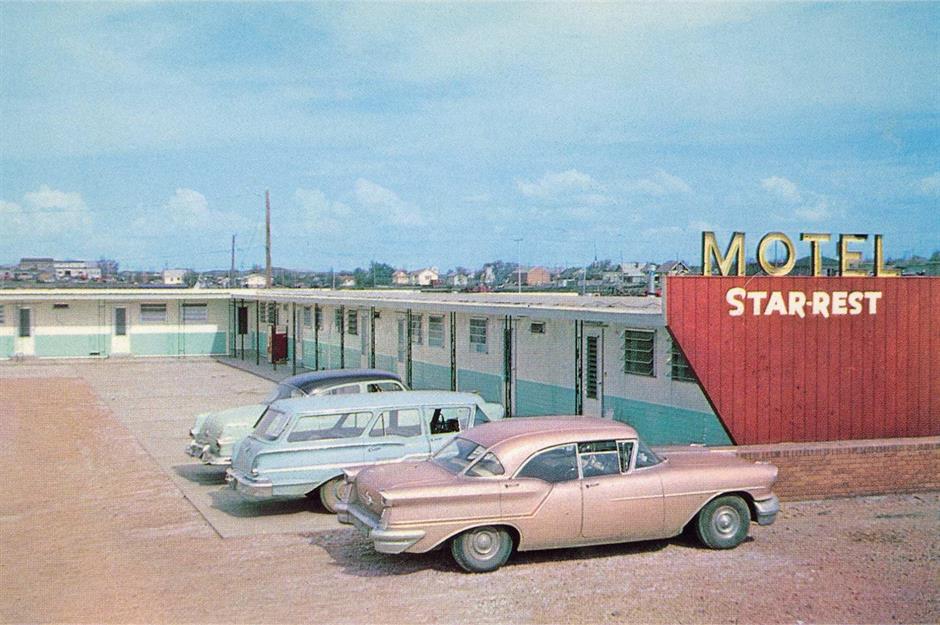
1950s: motels and diners spring up everywhere

Now that more Americans were taking to the road during their vacation time, they needed a place to stay. So the neon signs of motels and diners became an increasingly common sight along the country’s highways. A classic “mom-and-pop” motel would offer affordable lodgings, a place to park up for the night, and often a diner serving home-style food.
1960s: Route 66 gains notoriety

The first all-weather road between the Midwest and the Pacific Coast, Route 66 revolutionised the road trip. It shaved some 200 miles (322km) off the journey between Chicago and Los Angeles, making it easier for people in the rural west to get to cities in the midwest and northeast. In 1960, Route 66, an American TV series that followed the escapades of a pair of young men travelling the route, aired on CBS. As the so-called Mother Road continued to crop up in popular culture, America's fascination with her grew.
1960s: Aristocrat is the top trailer maker

Sponsored Content
1960s: camper vans make waves

1970s: VWs dominate the hippie trail

1970s: more campsites spring up

Sponsored Content
1970s: trailers experience a fall from grace

1980s: motels shut their doors on Route 66

1980s: NASCAR fans gather at Daytona International Speedway

Sponsored Content
1980s: RVs become more advanced

After a lag in the 1970s due to the oil crisis, the RV industry boomed during the 1980s. Popular movies including National Lampoon's Vacation and The Blues Brothers, whose storylines heavily featured the motorhomes, helped to cement RVs’ place in popular culture. The iconic RV of the decade was the Fleetwood Bounder, released in 1985, which was the first of its kind to include basement storage – now a common fixture in these vehicles.
1990s: tourists take in Alaskan scenery

1990s: old-school trailers are back

Sponsored Content
1990s: Big Sur maintains its magic

Made popular by the Beat Generation in the 1950s and the hippies of the 1960s, central California’s Big Sur is one of the most popular road trips in the country. Highway 1 is the iconic route which takes travellers along this rugged coastline, with the most visited stretch running between Santa Barbara and Monterey. Here, a classic 1990s compact car drives alongside the sun-splashed cliffs.
2000s: the most popular RV

2000s: drive-thru in Maryland

Sponsored Content
2000s: remnants of Route 66

By the 2000s, the historic Route 66 had become a tourist attraction in its own right, with plenty of motels, diners and even a museum profiting off its storied past. At this section near Prewitt, New Mexico, photographed in 2003, the road runs parallel to Interstate 40. It seems a fitting visual metaphor, given the road was ultimately surpassed by the high-speed interstate highway system.
2010s: navigation gets an upgrade

2010s: camper vans powered by solar

Sponsored Content
2010s: road tripping goes electric

Until very recently, long-distance travel in an electric vehicle has felt like a distant dream. But thanks to the rapid improvements in EVs themselves, which mean they can travel for longer distances, as well as the installation of new charging points across the States, electric-powered road trips look like an increasingly viable option. And a new cross-country network of EV charging points, running from Los Angeles, California to Washington DC, is making it easier than ever to refuel. Pictured is a motorway sign for a charging point along southern California’s Pacific Coast Highway.
2020s: a pandemic causes problems

The start of the 2020s saw a curveball thrown at the travel industry: the COVID-19 pandemic. Popular destinations, such as Las Vegas (pictured), had their income from tourism almost completely slashed overnight, as lockdowns took hold and flights were cancelled. However, when Americans were allowed to travel within the USA again, road trips experienced a renaissance: a survey for Vacationer magazine estimated that 80% of Americans planned to take a road trip in 2022. Many were keen to avoid airports and flying for fear of contracting the virus, and the open road offered a safer way to satisfy the wanderlust.
2020s: remote working on the road

Another unexpected twist from the pandemic was the rise in remote working, which made long-term 'workations' a genuinely feasible option for many: one 2022 survey of RV owners revealed that over half had worked while on the road that year. Looking into the future, an increased awareness of the impact of flying on our planet means travellers will be looking for a different kind of trip, and driving through dramatic landscapes with the ability to stop anywhere certainly presents a more ecological and enriching alternative. It seems the freedom of the road will always beckon.
Next, discover the amazing experiences you can only have in the US